
Deployed AI to turn EHR data into study-ready datasets


Hey YC community! 👋
We’re Ritvik and Supratik, brothers and co-founders of Sutrix. We turn EHR records, surveys, and wearable data into analysis-ready datasets for healthcare research teams.
TL;DR
Patient records documents care as it happened, but the information a study needs is often scattered across notes, visits and systems. Each study has its own criteria, time windows and outcome definitions. When those requirements change or new data arrives, teams have to rework datasets, delaying answers about which treatments work best and for whom. Sutrix deploys AI software to turn the team’s existing data into study-ready datasets. It flags unclear cases for review with supporting evidence and lets teams reuse the preparation workflow across analyses as records or study definitions change. Across 10+ institutions, it has cut data preparation time by 80%, helping teams build evidence faster for more personalized care.
Ask: Know a healthcare research team spending more time preparing data than analyzing it? We’d love an intro: founders@sutrix.ai.
Check out our launch video 👇
https://www.youtube.com/watch?v=j-EwkyX0_0o
❌ The problem
Healthcare research teams have no shortage of patient data. However, it is scattered across EHRs, clinical notes, surveys, and wearables, with different identifiers, codes, units, and time points. Bringing it together requires understanding what each record means. An unusual measurement could be a unit mismatch or an entry error. A blank response could be missing or intentionally skipped. Those cases need different handling, and the wrong choice can change the results.
Each study adds its own definitions of which patients qualify, which observations count, and how outcomes are calculated. Teams need to trace those decisions to source records and study rules, apply them to new data, and revisit them when the study changes. That repeated interpretation and checking keeps studies waiting for months, even when the analysis itself is straightforward.
What Sutrix does
Sutrix carries your study’s definitions through the full workflow: pulling records, preparing the analysis table, reviewing exceptions, and keeping it up to date.
1. Connect and reconcile the source data
Sutrix brings together patient data from EHRs, clinical notes, surveys, wearables, and other study sources. It links each patient’s records and standardizes codes, units, and formats.
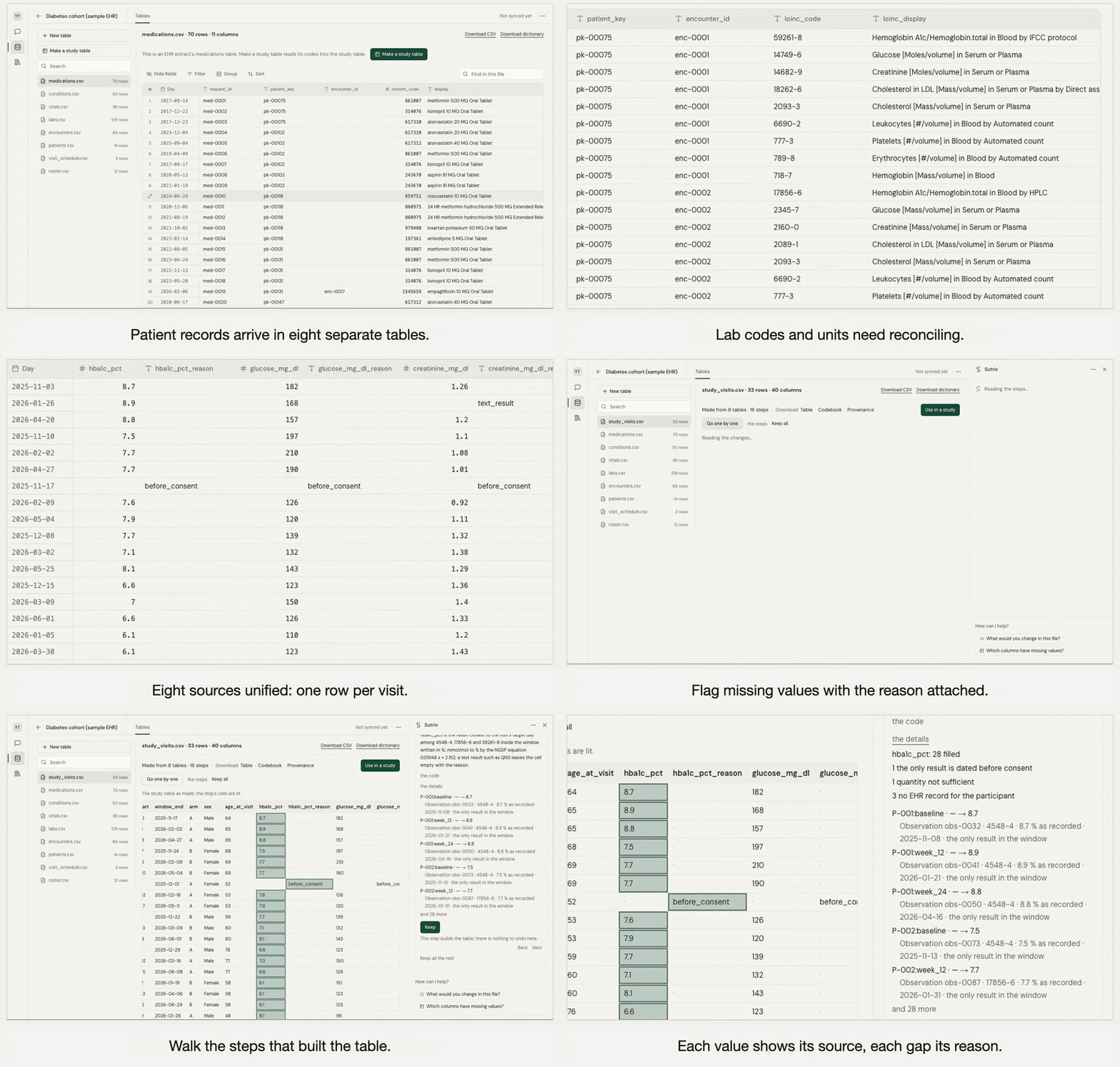
Inspect the source, rule, and conversion behind a prepared value. Unclear cases go to your team for review, with the evidence attached.
2. Build the dataset your study needs
Apply a saved definition set or specify the study’s rules. Sutrix builds the cohort, derives the required variables, and produces the analysis table with one row per patient, visit, or time period.
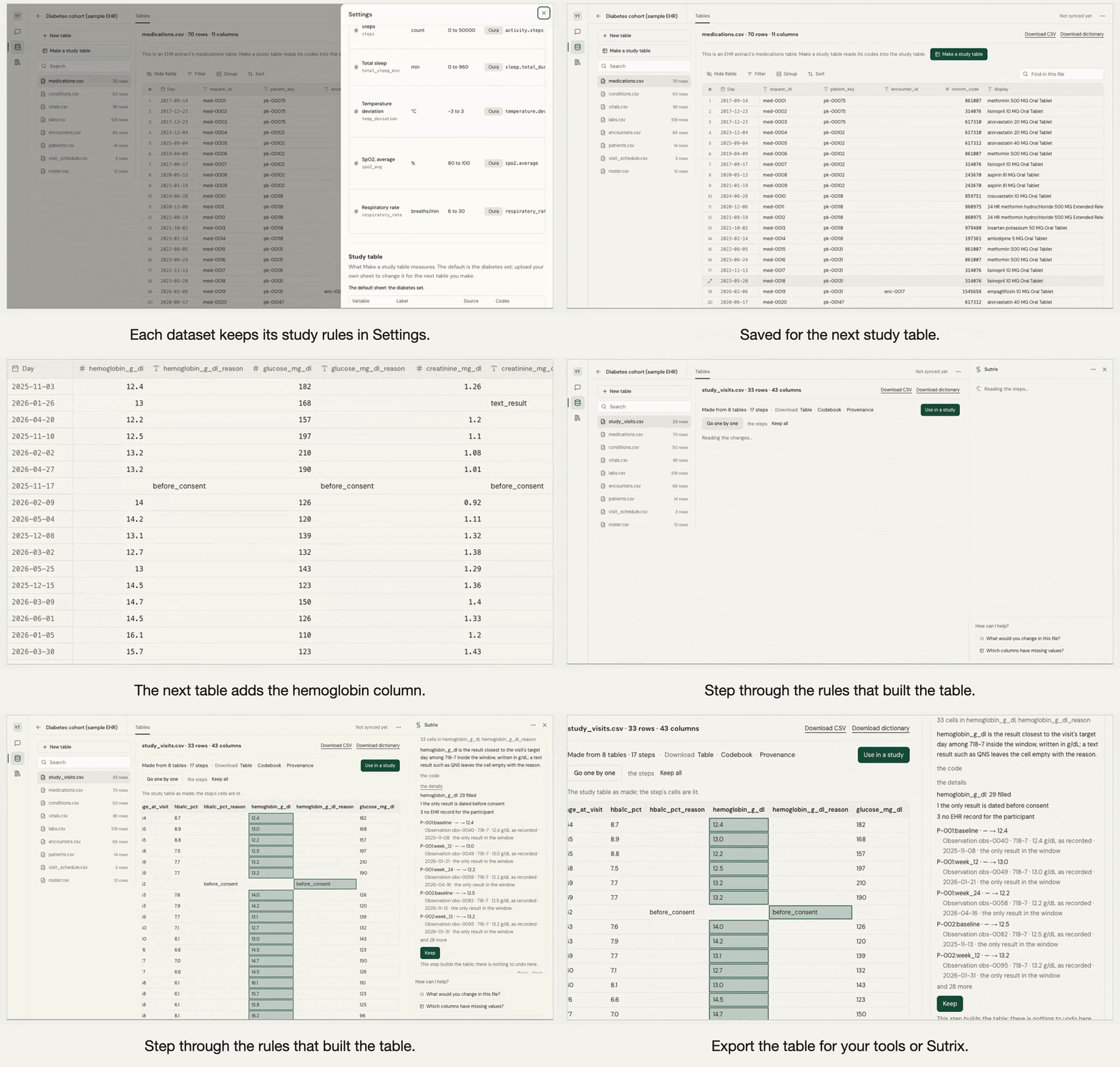
When new records arrive, run them through the same preparation rules. When definitions change, update the rules and regenerate the affected cohort, variables, or time windows. Then run the analysis on the revised dataset.
Results
Across 10+ institutions, we’ve cut data cleaning and preparation time by 80%, giving healthcare research teams a faster path to the evidence they need to tailor care for patients.
Why us
We’ve built together for four years. Before Sutrix, we built an injury surveillance system at Hospital for Special Surgery (HSS), now used by 700+ teams. We saw this preparation work firsthand and fixed it.
Ritvik (CEO): Published clinical researcher at HSS, Emory, and Georgia Tech. Led a 300-participant, IRB-approved concussion study.
Supratik (CTO): Founded and exited a company backed by a16z Speedrun, built production AI agents at Amazon, and left Georgia Tech at 18.
🙏 Our ask
If you run or support a healthcare research team, we’d love to talk. If you know someone who does, we’d appreciate an intro.
Email us at founders@sutrix.ai

